From the Earth to the Moon by Jules Verne; Lowell Bair
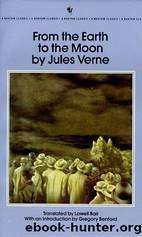
Author:Jules Verne; Lowell Bair
Language: eng
Format: mobi
Tags: Fiction, Interplanetary voyages, General, Literary, science fiction, Adventure fiction, classics
ISBN: 9780553214208
Publisher: Random House of Canada
Published: 1993-05-01T05:37:21+00:00
CHAPTER 15
THE FESTIVAL OF CASTING
DURING THE eight months that were spent on the excavation, the preparatory work for the casting had been done simultaneously and with great speed. A stranger arriving at Stone Hill would have been amazed by what he saw.
Arranged in a circle around the pit with a radius of 600 yards were 1,200 reverberatory furnaces six feet wide and three feet apart. The circumference of this circle of furnaces was over two miles. They were all built to the same design, with a high rectangular chimney, and they produced a singular effect. J. T. Maston felt that it was a magnificent architectural arrangement. It reminded him of the monuments of Washington. For him, there was nothing more beautiful anywhere in the world, not even in Greece, where, he freely admitted, he had never been.
It will be remembered that in its third meeting the committee had decided to use cast iron, specifically the kind known as âgray,â to make the cannon. This metal is tougher, more ductile, easier to bore, and suitable for all casting operations. Melted with coal, it is of superior quality for things that require great strength, such as cannons, steam engine cylinders, hydraulic presses, etc.
But it is seldom homogenous enough when it has been melted only once. It takes a second melting to purify and refine it by ridding it of all its earthy residues.
Therefore, before being sent to Tampa, the iron ore, melted in the blast furnaces at Cold Spring and placed in contact with heated carbon and silicon, was carburized and transformed into cast iron.* After this operation, the metal was sent to Stone Hill. But 136,000,000 pounds of iron would have been too expensive to send by rail: the transportation charges would have doubled the cost of the iron. It seemed preferable to charter ships in New York and load them with the iron in bars. It took no less than sixty-eight ships with a capacity of a thousand tons each, a veritable fleet. On May 3 they left New York harbor, headed out to sea, moved southward along the coast to the Straits of Florida, rounded the tip of the peninsula and steamed into Tampa Bay on May 10. They all moored in the port of Tampa without incident.
There the metal was unloaded from the ships and placed in the cars of the Stone Hill railroad. By the middle of January all of the enormous mass had reached its destination.
It will easily be seen that the 1,200 furnaces were not more than was needed to melt that 70,000-ton mass of metal all at once. Each furnace could contain about 114,000 pounds of metal. They had been made on the same pattern as those that had been used in casting the Rodman cannon: they had a trapezoidal shape and were very low. The heating apparatus and the chimney were at opposite ends of the furnace, so that it was equally heated over its entire length. These furnaces, made of firebrick, were composed only of a grate for burning the coal and a hearth on which the bars of iron were laid.
Download
This site does not store any files on its server. We only index and link to content provided by other sites. Please contact the content providers to delete copyright contents if any and email us, we'll remove relevant links or contents immediately.
| Fantasy | Gaming |
| Science Fiction | Writing |
Sita - Warrior of Mithila (Book 2 of the Ram Chandra Series) by Amish(55279)
The Crystal Crypt by Dick Philip K(37048)
Cat's cradle by Kurt Vonnegut(15549)
Ready Player One by Cline Ernest(15139)
Always and Forever, Lara Jean by Jenny Han(15066)
The Last by Hanna Jameson(10377)
Year One by Nora Roberts(9953)
Persepolis Rising by James S. A. Corey(9564)
The remains of the day by Kazuo Ishiguro(9211)
Never let me go by Kazuo Ishiguro(9095)
Red Rising by Pierce Brown(8987)
Dark Space: The Second Trilogy (Books 4-6) (Dark Space Trilogies Book 2) by Jasper T. Scott(8327)
The handmaid's tale by Margaret Atwood(7902)
Frank Herbert's Dune Saga Collection: Books 1 - 6 by Frank Herbert(7339)
The Circle by Dave Eggers(7249)
The Testaments by Margaret Atwood(7090)
Legacy by Ellery Kane(6761)
Pandemic (The Extinction Files Book 1) by A.G. Riddle(6663)
Six Wakes by Mur Lafferty(6398)
